|
|



Afterglow The Liner Notes |
Candle in the Night, produced by Phase II and Bruce Clement, was recorded at KUNC-FM studios, Greeley, Colorado, and originally aired 14 October 1978. The Phase II extended play record was produced in 1979 by Phase II and recorded at Eaglear Studios, Johnstown, Colorado; engineered by Dwight Oyer. Guest drummer: Bill (Will) Gleisberg All other songs were recorded between 2007-2008 by Nicholas Tesluk and Mark Andrews at Phase II Sound Studios. Nicholas Tesluk: 12-string acoustic guitar, electric guitar, flute, recorder, vocals. Mark Andrews: Keyboards, mandolin, recorders, electric guitar, vocals. Additional drums/percussion: Cyrus M. Beatty Afterglow was produced by Phase II, Axel Frank and Max Percht, with final mastering by Axel Frank at Blue Lounge Studios, Berlin, Germany. Cover, booklet, disk artwork: Nicholas Tesluk |
Front cover |
Nicholas comments: |
Mark comments: |
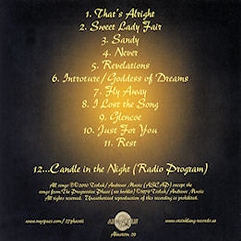
Back cover |
Disk label |
Booklet cover |
1. That's Alright (Music: Tesluk / Lyric: Andrews) |
2. Sweet Lady Fair (Tesluk) |
3. Sandy (Andrews) |
4. Never (Music: Tesluk / Lyric: Andrews) |
5. Revelations (Andrews) |
6. Introture / (Andrews) Goddess of Dreams Phase II EP version (Tesluk) |
(See Phase II EP LinerNotes) |
7. Fly Away Phase II EP version (Andrews) |
(See Phase II EP LinerNotes) |
8. I Lost the Song (Music: Tesluk / Lyric: Andrews) |
9. Glencoe (Music: Tesluk / Lyric: Andrews) |
10. Just for You (Tesluk) |
11. Rest (Andrews) |
12./13. It Doesn't Really Matter (Andrews) |
15. Memorabilia (Music: Tesluk / Lyric: Taylor) |
16. Lament (Tesluk / Andrews) |
17. Goddess of Dreams Candle in the Night version (Tesluk) |
18. Greensleeves (Traditional) |
19. Where Has She Gone (Andrews) |
21. Fly Away Candle in the Night version (Andrews) |
(See Phase II EP LinerNotes) |
I wrote "Goddess" in 1978. I was living in a "garden apartment" which is not quite a basement but also not quite ground level, so could be classed as semi-subterranean. Like something inhabited by creatures of the night. The advantage of the flat being partially buried was that the internal temperatures would stay cooler in the summer and warmer in the winter. The rather large disadvantage was that the bottom of the ceiling level windows were at ground or "sidewalk" level at the exterior. Thus, with all of the drapes open it was like living in a cage at the zoo where every passerby could look into my apartment to see what was happening down there. One afternoon, as I sat inside reading a book, an attractive, golden-haired (of the Clairol variety :o)) lady friend of mine who lived above me in my apartment complex happened to be passing by. I liked her sense of humor and enjoyed talking to her whenever we met, so I began a conversation through the open window of my living room below. Though our friendship was platonic and never progressed beyond that stage, I had always thought that it would have been interesting to have known her better. So as she strolled away down the walk after we had spoken awhile, the lyrics of this song came to me in a rush. I set the lyrics to music shortly thereafter. |
It was around 1980. Nicholas and I were the only ones in the practice room (also known as "the Nicholas Tesluk basement") the night he debuted this song for me. I was immediately transported by its heartaching, heartbreaking poignancy, and worried about how I could ever musically match the emotional extremes it made me feel deep inside. Nicholas pulled his chair close to my keyboards and played and sang the song over and over, while I felt my way through an ever-evolving synth arrangement. Once we both felt good with what we had, we performed it one more time for a cassette deck recording. And then... inexplicably, the tape was filed away and forgotten! Jump ahead to 2007. Imagine the thrill when, digging through my old Phase II practice tapes, I came across the one lone, original cassette copy we had made way back when. What you hear on this recording is a polished version of that exact arrangement from so many, many nights ago. Nicholas was candid enough to mention the origins of this song, along with its original title. For my part, I think the current title most appropriate, as I find this song, an exemplary love ballad in the classic sense, to be a universal tribute to all sweet ladies fair, wherever they may be. |
Sometime in the late 1970s, Nicholas gave me a cassette tape demo, featuring his vocal and 12-string guitar, of a new song he had composed based on a lyric of mine called "Never." As time and fate would have it, we never ("Never" indeed!) worked the song up into Phase II's repertoire , and that cassette languished in a bag of Phase II practice tapes in the back of closets in Colorado, Indiana and New York. But never say never... In October 2006, as Nicholas and I first toyed with the notion of a re-formed Phase II, I digitized many of our old practice tapes and sent mp3s to him. Not only did he not recognize his old "Never" demo, but couldn't understand why the guy singing it was impersonating him! "Never" now has the distinction of being the very first song Nicholas and I recorded together in the 21st Century, more than enough reason for it to have a very special place in my heart. |
Another lovely Tesluk composition of which Nicholas had no memory. On one of my old Phase II practice tapes, one not only hears Nicholas's voice and 12-string guitar, but our drummer and bassist accompanying him as well, with occasional awkward and embarrassing attempts by me to develop some sort of a keyboard part. We ended up reconstructing this in 2007 from that old recording - and after 30-odd years, I finally came up with a keyboard part I liked. (What I lack in speed I make up for in enthusiasm!) The choral vocal effects (which we refer to as the "La-las," and which we had great fun with) just evolved out of the modern arrangment. As for Nicholas's habit of intentionally throwing in the occasional extra beat, it's usually confounding, but ultimately always catchy; and once the rhythm sinks in, I couldn't imagine doing it any other way! |
In 1979, Nicholas and I, along with a group of friends, made a pilgrimage to the cinema for the excellent new Who rockumentary The Kids Are Alright. The film left me itching to write a classic British-style rock anthem (think The Who, The Move, or The Pretty Things, circa 1968). A few nights later, still on a "Who high" (and having just heard the final strains of Pete Townshend's "Love Reign O'er Me" while gazing up at my overflowing bookshelves), I began scribbling out intertwined thoughts on a bloody great British invasion band, on literature and the vagaries of getting published, and on being lonely, not necessarily in that order. "Revelations" probably veers in the British rock anthem direction, though I couldn't help adding a few baroque chord progressions and a tendency to ping-pong between minor and major modes. For this recording, we slowed things down a bit, giving it more power and majesty. I also let myself be distracted by some psychedelic tangents, particulary in the opening and in the bridge, which we reworked significantly. And I have to say, I find Nicholas's electric guitar leads - the way they snarl and growl - absolutely stunning! |
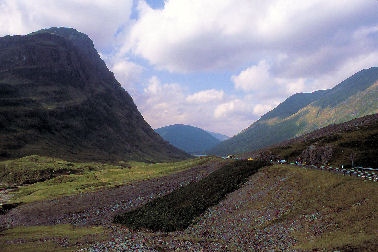
A new recording closely based on our original live arrangement, "Glencoe" was one of our earliest collaborations (and probably my first attempt at documentary songwriting). The story told is of a night in 1692 when two British companies of mostly Campbell troops being billeted by the MacDonalds of Glen Coe rose up and began murdering their hosts. Having driven through this rugged, now mostly empty valley a number of times, I'm always struck by its awesome beauty and eerie emptiness. The story was relevant to me by way of my heritage: My mother is a Cameron, a large highland clan with strong traditional ties to the MacDonalds and land holdings bordering Glen Coe to the north. As for lasting social ramifications of the massacre, I guess time heals all. (Today I even count a couple of Campbells among my circle of friends!) |
Nicholas's poignant love song holds another special place in the Phase II canon by being the band's first new composition of the 21st Century. In his notes, Nicholas is almost apologetic in his discussion of the song's simple melody, but I beg to differ. Upon listening to his demo, it was not a stretch to approach "Just for You" as a modern art song. I certainly wasn't put off by any melodic simplicity. Many of my favorite art song composers, including Schubert, Brahms, Grieg, (Richard) Strauss, Mahler (particularly in his Songs of a Wayfarer), Bartok and Vaughan Williams, have drawn on the 'simpler' folk melodies of their youth, understanding that such music speaks to us all, because the experience of youth is one of those few things we all have in common. For me, it is often that very evoking of youth past that gives a song its depth of feeling; that is particularly the case with Nicholas's tale of a love "separated by time." Though I remain uncertain whether the song's happy ending is reality or only the singer's wishful thinking, what is most important to me remains his overwhelming ache of desire. It was a great challenge and joy to be able to lend the song a "classical" arrangement, though our pseudo chamber orchestra almost loses its way in the psychedelic swirls of the bridge. (It was also a great test of the digital sonic capabilities of my Yamaha SO8 synth.) Does the song somehow break with the "Phase II sound"? I hope that one of our strengths is versatility with an ability to surprise (just as I remember being surprised the first time I heard the song "Eleanor Rigby"). Put simply, I think it is our duty, as musicians, to try things. |
All content © Tesluk/Andrews Music 2010 [Last updated 28 July 2013] |
As part of our acoustic phase, we recorded the "Candle in the Night" radio program over a period of about a week in the month of August, 1978. On the night that we recorded the beautiful and lilting "Where Has She Gone", the program's producer, Bruce Clement, invited two of his friends, Dan and Barbara Hanna, to the recording session. I vividly remember the evening. I thought Dan was a pretty cool guy but I was absolutely stricken by Barbara's gentle beauty. Though we all saw each other again at a few gatherings in the next few months, it wasn't until later that I found that their seven-year marriage was coming to a tragic end. Their divorce was final in 1979 and Barbara and I wed in 1980. This song was thus written as a testament to our first meeting in the studio of the radio station and my undying love for her. Now that it has been several years since our twenty-two year marriage ultimately succumbed to a similar mournful fate, the original title, "Barb's Song", was changed to protect the innocent. A memory has stayed with me of Mark saying (after hearing the song on the night that I debuted it for him) that the music, especially the part "And the seed.....", followed by Mark's then newly created instrumental bridge, reminded him of French film music. Upon hearing that, I surely realized that it was true as I imagined a chorus of soprano voices "la-la-ing" that portion of the melody in a sixties French film. For that matter, my all-time favorite film composer, Ennio Morricone, has used similar strains, also with a female chorus. |
Well, what can I say? I suppose it's to my credit that the only two songs that I completely and utterly forgot were "Never" and "I Lost the Song". As stated in the liner booklet of "The Afterglow" phase of the album, it must have been the stress of the breakup of the group that caused me the anxiety to absolutely blank out these two songs. And also given the fact that, as Mark states, we didn't really develop them past the initial writing and rough recording stages. But, casting modesty aside, what a treat to find out that I absolutely loved this song that I had co-written when it was reintroduced to me. It was the first song we developed and recorded after reuniting, and when I heard the glorious piano bridge that Mark created, I was positively spellbound. As I told him at the time it reminded me of a combination of Dave Brubeck and Floyd Cramer, two of my all-time favorite pianists. Now, after countless hours of listening to the song and playing and singing it, I never (yes, "Never") seem to tire of it. |
I recently purchased the DVD of The Kids Are Alright, mentioned in Mark's comments and watched it again and was as transfixed as Mark and I were when we watched it in the 1979 theatrical release. I watched it once more with my daughter, who is quite a fan of The Who's music, but she hadn't realized until then that it was Pete Townshend's genius that created all of their fine songs. Mark's song is a unique and fitting tribute to one of the most enduring and inventive musical groups of several generations embodied within his own life experience. Quite an inventive touch. The new version of this song is a bit slower than the original with many added psychedelic overtones. I had quite an enjoyable time developing the backing vocals leading into the lead guitar bridges. |
No question about it, I truly did lose this song . But again, when I regained it, I loved it. The music I had composed for the song was a bit quirky in the timing between lyrical phrases, and when recording it for Afterglow, I tried to keep most of that quirkiness intact since it added a certain charm to the song. Of course, this adds to the complexity of rehearsing, recording or performing the song since one must remember to count, say, five beats instead of an even number like four or eight. Fortunately, Mark is a pro at adapting to some of my quirks :o). I must give him full credit for initially devising the "La-las" as they just worked so perfectly with this song. He also gets credit for the "rocking out" portion of the song, which was a truly fitting climax leading to the final sets of "La-las". |
Mark's haunting lyrics, which paint an eerie portrait of the ancient Scottish tale, were truly the inspiration for my music and I hope that I have complemented them well. The driving, even rhythm made this a great song to perform live in the days of our progressive phase. |
Not many years ago, in the process of doing my, what I term, "put the food on the table", work of servicing printers and copiers, I took a service call in a mortgage- loan office. While there, I met a lady who was half my age. There was something about her that made me think and dream about her long after I left the office, and reignited when I would once again return there. Though my life is usually an open book, I'll keep the outcome of this particular story a mystery. The song consists of a very simple melody and when I gave Mark the song to orchestrate and arrange, I told him to listen to it before looking at the rather elementary chord progression. Actually, quite unusual for me since I don't seem to have the term "3 chord song" in my vocabulary :o). I am somewhat redeemed by the switch to the minor key on the third verse. Mark took the baton and turned a simple song into a veritable symphonic masterpiece! There has been a bit of a buzz that this song, being our only new song on the album, didn't befit the 70s "retro" feel of the album. Not a bad commentary at all and it is actually quite insightful. Though Phase II began as a late 70s/early 80s group, we don't want to be stalled in some sort of time-warp. The Afterglow album put everything we had from that era (radio program, 7-inch EP, and miscellaneous early works) into one retrospective album. The new song was included not only to show that this wasn't just an album of some old music that we pulled off of a dusty shelf, but to point to the direction we will be taking in the future. As the ad says, "a launchpad". The songs we've written since, while certainly retaining our Phase II style, will bring a refreshing new element to our music that I don't think will disappoint. |
I vividly remember the day that Mark first played this song for me. I must say that it left me positively speechless! And this was just on an organ with no synthesizers or special "train" effects! But the haunting melody and the meaningful lyrics were just fantastic! In fact, through all of the years of Phase II's dormancy, I have found myself humming or whistling portions of "Rest" at various times throughout countless days. Of all the regrets I had when the group split, the most grievous was that "Rest" would never be heard by the public. It was just too great a song to be relegated to the dark and desolate dustbin of humanity. Now, due to the miracle of modern technology, it is better than ever, and I feel that it has reemerged in a cloak of numerous and vivid tonal colors. The authentic train effects, the dynamics, the wall of sound and the build to the grand finale just improved on something that was absolutely great from the beginning. |
In the summer of 1977, discontented with my life in Colorado, I returned to southern Germany where I'd spent the early 1970s. I was going to play in a band with which I'd had some history (most recently as composer/ lyricist). Blue Grass was popular in the Backnang area, but had recently changed its name to Yannis based out of Heilbronn. Traveling to band rehearsals one dreary winter day, I was one of a handful of passengers clacking along on a small local train through villages and farmlands between Heilbronn and Marbach. Bored by the intermittent fog, I leaned against the window and composed a tune to the rhythm of the rails. Suddenly, and with great force, the train ground to a halt in the middle of a fallow field. The door at the front of the car crashed open and the conductor stormed down the aisle past us and out the rear door. We could hear him hop down onto the rails and jog away in the direction from which we'd just come. After some time, the conductor, pale and visibly shaken, reentered through the coach's back door. He muttered quietly to a passenger at the back, then hurried away toward the front of the train. The passenger at the back spoke one word to the rest of us: "Selbstmord!" ("Suicide!") The story made the papers: A young man, barely an adult, whose fiance had died tragically just days before, "ran to meet the passing train," our train, in order to be with her once more. The experience haunted me for quite some time. In order to exorcise the ghost, this song - which includes the tune I heard in the train rhythms that eventful day - has acquired an almost celebratory feel. Rather than dwell on the inherent tragedy, I wanted to sing to the Journey - both the literal journey I took that day, and the metaphoric one taken by my fellow traveler. In our different ways, we were each looking for a bit of "Rest." |
This was Phase II's first recording of "Fly Away" - a song I'd only previously performed in Heilbronn, Germany (see Phase II EP Liner Notes). This radio version presents a true Phase II rarity: I was the lone guitarist (plugged through a sound-modifying Phase Shifter pedal for that appropriate windy sound), while Nicholas got a chance to show off his skills as a flautist. (And also shook some mean tambourine!) |
I like to think of this as another of our "first" songs. It seems to me it was the first song Nicholas wrote after the inception of Phase II, and as such, I believe "Goddess of Dreams" to be the very first song to have a Phase II arrangement from its very outset, although of course, we ultimately expanded the bounds of that arrangement in the more progressive version (see Phase II EP Liner Notes). In this radio version, the song is carried by Nicholas's lead vocal and amazing 12-string guitar work. I provided alto recorder parts, some electric lead in the bridge, and harmony vocals. Though a few grains of Nicholas's "sands of time" have slipped away since we first performed this song, I know that his "Goddess" will remain a part of us forever. |
This is the second-oldest song on the Afterglow recording (the oldest being the Changes song "Memorabilia"). I wrote this in early 1977 during a particularly brutal period in my emotional life. Being someone in real life who tends to over-analyze everything that goes wrong, it was particularly cathartic for me to play the part of someone who hides behind the 'certainty' that nothing really matters. In the radio version, Nicholas played his 12-string while I played a heavily phase-shifted electric (and tried most sincerely to emulate an occasional Neil Young-style lead). The reprise of the song at the very end of the radio show (Track 23) again featured Nicholas on 12-string, while I traded the electric for a classical guitar. I'd performed "It Doesn't Really Matter" before in both band and solo settings in Colorado and Germany, but didn't grow to love it until it became a Phase II standard. |
A song with a very rich pedigree indeed. This is Phase II's version of a song by the classical folk group Changes, founded by Nicholas and his cousin Robert Taylor in the late 1960s. This track features Nicholas's intricate 12-string guitar styling and lead vocal, with me lending some electric guitar strums, harmony vocals, and an alto recorder solo. The first night Nicholas and I met, I remember we spent the evening sitting on the floor with mutual friends, leafing through a neat sheaf of Changes manuscripts, trying out this song or that one on our guitars and experimenting with different vocal arrangements. In retrospect, I think Phase II had to come about based on the way our ideas (not to mention our guitars and voices) melded on Changes songs like "The Saddest Thing" and "Sweet Eve." In fact, the exquisite "Bleeding Out Your Feelings Evermore" and "Memorabilia" became highly polished mainstays - one might even say anchors - of our acoustic phase. |
Sometimes during our early practices, we would loosen up a bit by improvising instrumentals using different instruments or trying to find new sounds. (Such pieces also came in handy in our other lives as strolling minstrels at the occasional Renaissance fair or Boar's head dinner.) Preparing for the radio show, we realized we could use some of these as musical interludes or bridges. "Lament" features Nicholas on guitar and me on alto recorder. I've always thought of this as our homage to the magnificent Ennio Morricone. |
Okay, this is hands down the oldest song in the Phase II repertoire, dating back to at least 1580 (per Wikipedia). Out of curiosity, I checked Amazon's CD search and discovered some 1500 versions currently available. (Of course, it's not too hard to understand why, after all these years, it's still being covered!) I think we originally worked up our arrangement for a Boar's head dinner event at a local university, but it served a similar purpose as "Lament" in our radio show. Nicholas provided the lovely classical guitar, and I got to play with one of my newer toys at the time, a tenor recorder. |
I recently found a copy of the words to this in a file of my old lyrics dating back to 1973, which means I had the lyric for this song floating around for a very long time before I added the melody. As for the question in the title, I can truthfully say I don't know where she went, nor do I have a clue who she was...(What fickle creatures we are!) Though I know the melody to be mine, I know I never did much with it as a song until Nicholas and I worked up the "Renaissance bridge" version heard here (with Nicholas on soprano recorder and me on alto). I have to admit, I've come to respect the song's simplicity, both of music and of text. |
This seemed the perfect song to use in its context on the radio program as it became what we've since referred to as "bookends" (with homage to Simon and Garfunkel), with the instrumental lead-in to the song being the introduction to the program with Bruce Clement's voice-over. This is followed by the body of the song which has a great melody and though the lyrics are of a deep despair, their poignancy develops a strong commiseration from the listener . Finally, the reprise at the end with the voice-over recap just gave the whole program an aura of continuity. |
In our acoustic phase, Mark and I performed several songs that each of us had penned before Phase II was founded. Most of the songs that I had written or co-written beforehand were part of my repertoire with Changes, the folk duo I had co-founded with my cousin and partner Robert Taylor. This particular lyric, written by Robert, has very beautiful and poignant lines that to me conjure images of an alchemist or wizard working in his darkened, secluded chamber. The song consists of three sections, each separated by arpeggios based on the chord of A-major (transposed to a B-major) which also introduce the song. While rehearsing the song in Mark's living room one afternoon, following the middle section of the song, I began playing the arpeggio bridge, Mark had his recorder in hand and quite spontaneously started to play along with the melody and we both evolved into another chord progression that brought us back again to the A chord arpeggio theme. Following two more lines of the "bridge" theme in the upper and lower register, I switched from A-major to an A-minor chord arpeggio and this was where the magic happened. Mark took off on the minor recorder melody that absolutely sent the bridge to another level befitting the somber and solitary atmosphere of the song. When we were done creating that, we just sat there, staring at each other, not believing what we had just created. |
Another bit of spontaneity between Mark and me. I had devised a lilting chord progression that had quite a melancholy feeling, and on the day I introduced it to Mark he took up his recorder and immediately composed this haunting melody. Though used as a background for the voiceover dialogue in the radio program so rather lost in the shuffle, I have always loved this little musical piece that we composed. |
Literally one of my very favorite songs of all time, the theme of "Greensleeves" has always held a special place in my heart. Loving the song as much as I did, I learned to play it as a classical guitar piece, for which I spent many hours delving into the lovely chord progressions of the song. Of course, when Mark added his beautiful recorder part to the song, it gave it a pastoral and baroque feel that became quite a typical theme of Phase II's acoustic phase. |
This was one of the most enjoyable songs to perform in our early days. Its catchy melody and dancing arpeggios made it a popular song despite (or due to) its simplicity. Performing it on stage (and recording it for the radio program) was great fun for when we'd reach the "Renaissance Bridge", I would continue playing the arpeggios on the 12-string, while Mark began his recorder part. Then while he soloed on the recorder for a few measures, I would pick up my recorder. We would then begin the duet. Following that, a lone guitar chord sets up the a cappella lines which we would sing (while setting down our recorders) and both break back into our guitar arpeggios for the ending. Not quite as complicated as it sounds, but we had to remain coordinated. |
"Fly Away" in the acoustic format had a beautiful and elegant simplicity to it. Being one of the songs that we performed both in our acoustic and progressive phases, the way this song changed, in particular, with the later addition of synthesized sounds, drew a fitting similarity to me of the progression of the early iconic music group, Jefferson Airplane into the later Jefferson Starship. Though this radio program was recorded in sections, each of the songs was performed "live" without any multi-tracking, so "Fly Away", being similar to the recording of "Where Has She Gone", was done by setting down one instrument and picking up another for the different sections and trying to set them down gently so as not to make an extraneous sound which would have been difficult if not impossible to erase from a stereo "live" track. |