|
|




Anecdotes |
All content © Tesluk/Andrews Music 2010 [Last updated 29 July 2013] |
The Scrapbook |
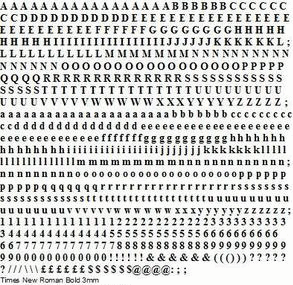
Nicholas: Recording back in 1979 was sometimes cumbersome, but I was recently thinking how the graphic work has been simplified over the last thirty-two years. Back then, to create, say, the cover of the Phase II EP, using scratchboard and India ink for the cover, adhesive spray to paste up the photo on the rear cover, and Press-Type to lay out the text took days to complete. With modern digital technology it could be done in an hour or two! Likewise, in order to create the cover and liner booklet of the Afterglow album (though, then, of course it would have been for a "state of the art" double LP instead of a "not yet invented" CD) in the early days would have taken months instead of just days. |
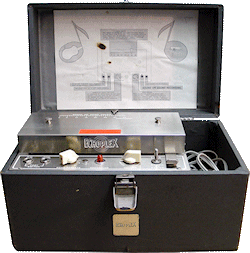
Eventually we found an Echoplex-style echo device (second-hand) at our friendly neighborhood music shop. It was a simple, but very effective vinyl-covered wooden box containing a loop of recording tape which would constantly run - at different adjustable speeds - around a record head and a multitude of playback heads. These playback heads could be moved closer to or farther away from the record head with levers, allowing us to add echoes that were truly out of this world to our recordings and live performances. |
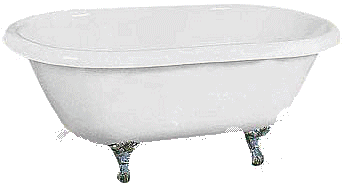
Mark: We often went to great lengths to achieve sound effects when recording song demos back in the late 1970's, particularly in our early acoustic duo days. I remember the thrill of discovering the incredible natural echo in the rather ancient tiled bathroom in my apartment. For awhile then, anytime we taped a song featuring recorder ("Goddess of Dreams" or "Memorabilia" come to mind), we'd aim a microphone at the bathroom ceiling, then I would kneel down over the lip of the old claw-footed bathtub (or just kneel in the bathtub itself) and play the recorder part down into the tub's giant porcelain shell to capture an echo at its grandest. |
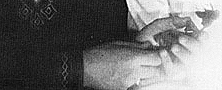
This shirt was made and the design embroidered by Barbara before we were married. I'm proud and glad to say it still fits me and I have actually worn it for some of my performances with Changes. At least, having only worn it for performances has kept it from becoming threadbare in all that time. |
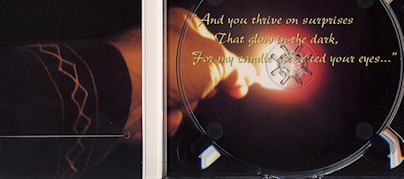
Nicholas: If one is observant when looking at my arm with my hand holding the lit match on the gatefold of the Afterglow album (a photograph taken last year)... |
...they may notice that I am wearing the same shirt as the one I wore for the back cover of our Phase II EP in 1979. |
Mark: I generally remember the days we spent at Eaglear Recording Studio as a time of great artistic satisfaction and extreme physical discomfort. The summer days were long and hot, with a sun beating down on the roof of the one-story studio building, creating a dry sauna-like heat inside. To up the level of discomfort, the studio's air conditioner was turned off during recordings due to its noisy fan. Despite the fact we were "on the clock," we frequently escaped to the slight breeze outdoors just to cool down - or in my case, to fill my lungs with a fog of nasty, tasty tars and nicotine. There were various forms of livestock wandering around the farm next door. I was intrigued by a 25-pound turkey checking me out as he strutted about the yard. I clucked at him, and he immediately approached where I was sitting atop a tree stump. I patted my legs, encouraging him to hop up on my lap so we could play, but was astounded when he immediately took me up on my invitation, almost knocking me off the stump. Before we could engage in friendly turkey games, he began kicking me in the stomach, scratching my arms and pecking painfully at my hands and face. I laughed and tried some turkey diplomacy, but his pecks grew ever more vicious. I pushed him away, but he charged me again and again, pecking at my legs and trying to jump back up to scratch out my eyes! I jumped up and retreated back toward the studio door. He calmly watched me go, then returned to strutting about his territory. Nicholas was trying hard not to laugh. I found myself wondering how well this foul fowl would fit in my oven. |
Nicholas: One of the highlights of our progressive phase was the time we performed as the opening act for an unlikely pair of performers, The Ozark Mountain Daredevils and The Amazing Rhythm Aces in the also unlikely location of the city's (Greeley, Colorado) rodeo grounds for their annual Forth of July celebration. Though the 1500 or so members of the audience came to hear an entirely different type of music, they seemed to enjoy the unique sounds of Phase II. An interesting and humorous sidenote to this performance was the audition. The organizers, looking for an opening act, contacted Phase II's promoter and it was mutually decided to hold the audition in my basement (where the group normally rehearsed). The rehearsal room ran the entire length of my house but was half the width, thus making it a very long, narrow room. It was set up like a stage with the drummer at stage right, me (at guitar) and the bassist in the center and Mark with his bank of keyboards at stage left. The sound/lighting man was set up at a console directly across the short width of the room from the me and the bassist. Though stage-like, there was not much space between the band and the audience "seating area". On the evening of the audition, the event promoters, Bill Scoggins and John Crossant, were directed to the rehearsal room and seated next to the sound console. Phase II opened with a song to set the atmosphere which was truly enjoyed by the guests. The band immediately followed this song with the song "Rest", penned by Mark (now appearing on the Afterglow album). The song builds like a train locomotive traveling at high speed and the lighting technician alternately flashes several colored lights indicative of train signals on the otherwise darkened "stage". At the end of the build, there is a crescendo of wild notes followed by the climactic final chord at which time the stage technician would hit the switch to explode the flash pots (steel canisters holding bright but relatively harmless flash powder of the type used by early photographers and magicians of all time on stage), one of which was only a few feet in front of our two-man audience. Whenever these flash pots were ignited, the band's personnel would have to immediately open the high basement windows to allow the billowing smoke to escape before the room's inhabitants began coughing, gagging or choking. The two gentlemen were duly impressed and Phase II was awarded the job of opening act for the rodeo ground celebration. However, Mark and I always considered ourselves fortunate that the two gentlemen were very good sports and that neither had a weak heart, and also that neither man soiled himself. |
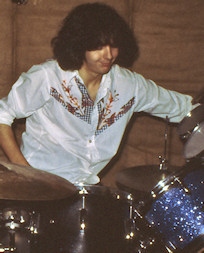
Mark: While recording the Phase II EP at Eaglear Recording Studio, the first few days were spent getting the rhythm tracks -- the drums, bass, and basic guitar rhythms -- down on tape so we could subsequently concentrate on adding the additional tracks -- keyboards, recorders, guitar leads, mandoline, vocals -- to fill out our rather elaborate song arrangements. To this end, we had the first of our four drummers, the amazing Bill Gleisberg, with us for those initial rhythm section sessions. Besides being an extremely talented percussionist, "Billy" was also something of a 'character.' He was what one might call a "man-child," if not for the fact that his young age and even younger attitude made him seem like more of a "child-child." |
The studio was located just outside of Johnstown, Colorado, then a sleepy farm community on the prairie right at the edge of the Rocky Mountain foothills. One day, Nicholas, Billy and I dropped into a suitably grungy Mexican diner in downtown Johnstown for lunch. As Nicholas and I debated the relative merits of chimichangas, tostadas and smothered burritos, Billy announced he was in the mood for a bowl of "chili," that ever-popular (though hardly Mexican) beef and bean stew named for its primary spice, a powder made from a generally mild red chili pepper. The waitress, who spoke little English, seemed a bit surprised at his order, but went back to the kitchen without a word. |
When our lunches arrived, we realized why she'd been surprised. The chili he had ordered was actually a large plate of various roasted chili peppers, meant as a condiment for those who like to add an extra spicy kick to their food. Nicholas and I suggested calling the waitress back and ordering something more appropriate, but Billy, not wanting to admit his error, wouldn't allow it and proceeded to pop fiery jalapenos and diabolical habaneras into his mouth, one after the other, while we watched, mesmerized, as his face turned a deep purple and great beads of sweat broke out on his forehead. It became an effort for Nicholas and I to enjoy our own meals. Billy eventually choked down the entire plate of peppers, along with a full pitcher (or two) of ice water. Later that afternoon, it seemed to me his drumming was twice as fast as usual. |
Nicholas: Being an opening act, especially a relatively obscure local group opening for pompous and relatively famous prima-donnas [like The Ozark Mountain Daredevils and The Amazing Rhythm Aces] was pure crap! Though we were liked and well-respected by the aforementioned show organizers, the agent and sound technician who came with the famous groups were nasty and treated us like scum-balls of the earth. The sound technician had the nerve to tell me, after I told him to lighten up: "Welcome to the world of opening acts". |
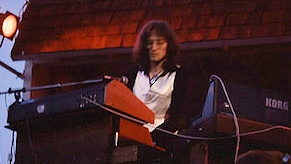
Mark: Opening for The Ozark Mountain Daredevils and The Amazing Rhythm Aces was thrilling, but also a harrowing experience for our little upstart progressive band. We were promised we'd be allowed to set up toward the front of the stage once the other two bands had set up at the heart of the stage, long before the gates opened that evening to allow spectators into the arena. We were promised an opportunity to get tuned up and have a full sound check before the gates opened. We were promised that our sound man would be allowed to stand with the concert's main sound tech and cue him during our performance. We arrived around noon and proceeded to wait for our turn. And to wait. The two headliners bickered at every stage of set-up - who would be on which side of the stage, in what order would they perform, ... and who the hell had the keys to their equipment trucks anyway (yeah, that mystery took some time to solve)?! So we waited all afternoon for the divas to finish setting up and do their sound checks. That evening the show's start time had already come and gone by the time Phase II got the cue to set up our rather extensive equipment (I had five keyboards at that time), and we were also warned to "be quick about it"! Of course, the gates had been opened by this time, so over a thousand people were filing in watching us struggle to get our equipment up the stage stairs and into place. We realized with a sinking feeling that we could forget about getting a sound check! Worst of all, the rough jostling of my organ [insert favorite rude joke here] loosened its 12 vacuum tubes (responsible for the 12 notes in one chromatic octave), causing the instrument to go fatally out of tune! Doug Burrows, our bassist, made adjustments in the back with a socket wrench while I played one note after another and watched my electronic tuner, calling out which note to adjust and telling him when each had been brought back into tune! As it was, we managed to be fully set up and ready to play within about 20 minutes (something we would normally allow a couple of hours for). The stress of the moment (and its resultant adrenaline rush) had completely alleviated any butterflies I'd been feeling that afternoon. Our set, which kicked off just as the sun was setting, went extremely well, and the audience - not exactly a prog rock crowd - showed their appreciation at the end with an enthusiastic ovation. |
Though I have not attained the "stardom" of either of those bands, when I have performed as part of a headlining group, it was due to that wretched and demeaning experience that I have always done my best to see that all of of the opening and preceding acts were treated with the utmost respect. |
One final note: I'd noticed that one of the Amazing Rhythm Aces was actually hiding out on-stage, crouching down just behind me where the audience couldn't see him. I became vaguely aware, from time to time, that he was bobbing his head to our music. As our set ended and we took a bow and started breaking down, he came over and shook my hand saying, "You guys sounded great!" then hurried off to get ready for his own performance. Okay, so maybe they weren't ALL Amazing Rhythm "Asses" after all... |
At the opening of the performance, our manager at the time, Carl Jameson, wore my black, hooded, woolen cape and walked to the front of the stage and lit the sparklers before announcing our performance. Unfortunately, since it wasn't exactly dark yet, the effect that I had hoped for wasn't realized since neither the candlestick holder nor the metallic candle reflected any lights, as the lights weren't visible yet. But it was a good and symbolic idea nevertheless. After the performance, the large candleholder sat in the basement of my house. By the time we moved from there in 1987, Phase II was sadly a distant memory, and due to the weight of the candlestick, I just left it at that house when we moved. I've often felt sad that I didn't take it with us as I could have at least used it for an end table or something, and it would have been the biggest memento that we as Phase II would presently own. |
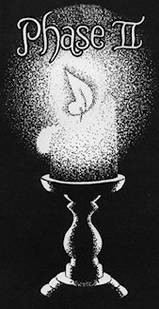
Nicholas: In preparation for the "Stampede" show, I had an idea to have a large version of our trademark candle made for the stage. The actual "candlestick" artwork was drawn from a wooden candle holder that I owned. So I carefully drew the image on graph paper to the correct proportions of the small one and enlarged the image about 500%. |
Thus the eight inch candlestick holder grew to a little over three feet in height. I took the graphed measurements to a furniture maker (believe it or not there was one in Greeley) who had a lathe big enough to produce this massive object! They explained that they would glue several blocks of wood together and carve this behemoth. The cost came out to, I believe, $180 which was a pretty large sum at the time. They did an excellent job of manufacturing the holder and needless to say, since it was solid wood, it was rather heavy. I painted it white so |
that when the colored stage lights hit it, it would reflect those colors. I then made a "candle" for it by taking a cardboard cylinder and covering it with aluminum foil. It wasn't exactly the shape of the melting candle on our image but it represented it well. Since the event was taking place on the day after the our July 4th Independence Day, firework "sparklers" were readily available so we fashioned a flame structure with three sparklers. The large "trademark" was placed at front center of the stage. |
Nicholas: Our sound man from mid 1980 until mid-1981 was a gentlemen and long-time friend of ours by the name of Steve Walker. He is a gentle and unassuming soul and was great working the soundboard. But what I remember most was his incredible knowledge of music trivia. He was a walking dictionary of the whole music scene as he had an intense interest in it all and was also able to retain it in his memory bank. |
Mark: Performing live with five analogue studio keyboards and reasonably complicated arrangements was at times daunting. Between songs, I needed a certain amount of time to reprogram the synths for the next song. As fast as I eventually got at sliding sliders, flipping switches, pushing buttons and repatching cables, at some points we had planned in extended talking breaks during which Nicholas could tell a story, a joke, or otherwise distract the audience from my frantic activities. |
Our sound tech, Steve Walker, knew our music so well that once he got our soundboard set up, he could lean back and mostly relax with his headphones cranked up and monitor our mix as we played, occasionally tweaking a channel higher or lower as need be to give an instrument a little more punch or mellow things out a bit. |
For example, I remember that a Denver rock station asked a question for which the ninth caller that knew the answer would win some prize. The question was "Before King Crimson, who did drummer Michael Giles play for"? Of course, I was familiar with King Crimson and also McDonald and Giles who came afterward, but I didn't have a clue as to who came before. |
I had been driving to my next copier service call and unfortunately couldn't stay to hear the answer on the radio. So later in the day, when Steve came over for our rehearsal, I asked him. Without hesitation, he said, Giles, Giles and Fripp! This was before the ease of finding something on the internet so it was great and amazing to have a resource like him. My daughter, Kristen, has a similar photographic memory for her interests of movie and music trivia (and believe me, I call on her often for information), but before she was old enough to cultivate this incredible storehouse of knowledge, Steve was the only human reference manual I had ever met. |
At one practice, we'd just finished a rousing version of "Goddess of Dreams" and I was routinely resetting my keyboards for the next song, a quiet ballad. In "Goddess of Dreams," I would program "Synthia," my small but potent effects synthesizer (a KORG MS-20), to trigger a tremendous booming crash of thunder, before which Steve would turn down Synthia's channel so as not to blow out any of Nicholas's windows! But in the following song ("Never So True"), he would boost Synthia way up, as I would reset her for that very soft and sweet flute solo of which she was capable. Only on this particular evening, I forgot. As he slid the volume up for my flute solo, I reached over and triggered a thunderbolt to terrify mighty Thor himself! Steve instantly flew backwards off his stool, yanking his headphones off in mid-fall and hurling them halfway across the room. |
Sorry about any possible hearing loss, Steve, and thanks again, wherever you may be... |